Common Flooring Mistakes That Cost Homeowners Thousands (And How to Avoid Them)
In 15 years, I've seen the same expensive mistakes repeated hundreds of times. Homeowners think they're saving money or making smart decisions, then call me 1-3 years later when their floors are failing. The worst part? Almost all completely preventable with basic knowledge. This article will save you thousands - I'm sharing the costly errors I see repeatedly and exactly how to avoid them.
Mistake #1: Wrong Flooring for the Space
The #1 catastrophic mistake:
- The errors: Hardwood in basements (moisture disaster), carpet in bathrooms (mold magnet)
- More errors: Cheap laminate in high-traffic (destroyed in 2 years), solid hardwood in kitchens (water damage)
- Why: "But I love hardwood!" - aesthetics override practicality
- Real disasters: $8,000 basement hardwood destroyed in 18 months, $3,500 laminate kitchen buckled
- Bathroom carpet: $2,000 removal + health concerns from hidden mold
- The fix: Match flooring to room conditions
- Smart choices: Moisture-prone areas (LVP, tile), high-traffic (durable hardwood, quality LVP), basements in Cleveland (LVP or tile ONLY)
- Before buying: Talk to someone who knows local conditions - Cleveland needs Cleveland solutions
Mistake #2: Ignoring Moisture Issues
Moisture kills floors - yet constantly ignored:
- Common scenarios: Basement no moisture testing, bathrooms no ventilation, concrete no vapor barrier
- More scenarios: Visible water stains ignored as "old damage"
- The timeline: Perfect (3-6 months) → slight issues (6-12 months) → obvious problems (12-18 months) → complete failure (18-24 months)
- By the time you see it: Damage is done
- Real example: Beautiful hardwood in basement, no testing/barrier, after 14 months cupping throughout
- Moisture levels: 8.2% (over 4% is problematic)
- The fix cost: $7,200 to remove, install proper barrier, reinstall with appropriate flooring
- That $500 saved: Cost $7,200 to fix
- What to do: Test concrete moisture, address visible issues, install vapor barriers, ensure ventilation, fix leaks immediately
- Testing reality: 15 minutes, $0-$100 vs. thousands in replacement
Mistake #3: Hiring Based on Price Alone
Cheapest bid rarely best value:
- What cheap installers skip: Proper subfloor prep, moisture barriers, acclimation, correct expansion gaps
- More skipped: Transitions done right, manufacturer-recommended methods
- You pay less upfront: Then pay again when floor fails prematurely, warranty void (improper installation), repairs needed
- Real comparison: Cheap $1,200 for 300 sq ft, Quality $1,800, Cheap fails in 3 years $2,500 replace = $3,700 vs. $1,800
- The stories: "Hired cheapest guy, looked great 6 months, then...", "Said moisture testing wasn't necessary...", "Finished in half the time you quoted, but now..."
- Every time: Cheap installation + floor failure = expensive do-over
- How to evaluate: Check reviews extensively, verify insurance/licensing, ask about process, understand inclusions, check warranty, meet in person
- If bid 30%+ cheaper: Something's missing - find out what
- Truth: Never had client wish they'd gone cheaper, dozens wish they hired me first time
Mistake #4: Skipping Subfloor Preparation
The foundation - mess this up, everything fails:
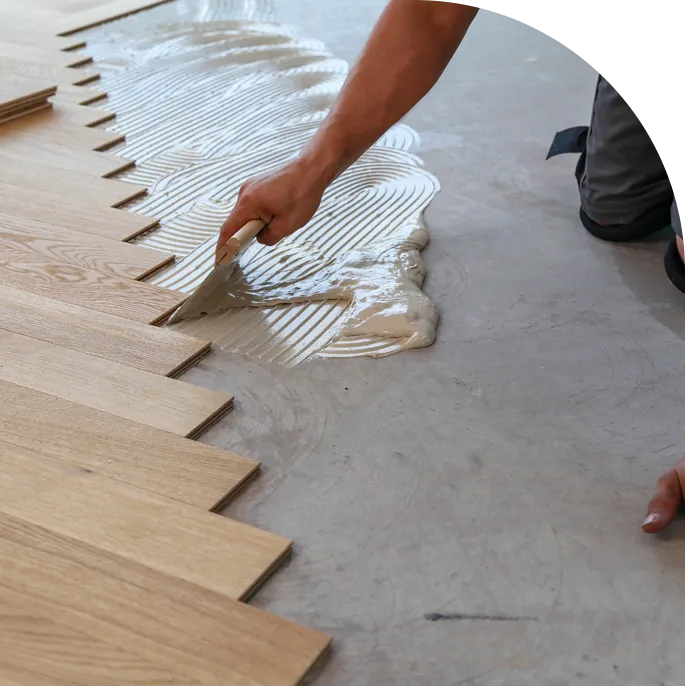
- Proper prep includes: Leveling to proper tolerance, cleaning thoroughly, repairing damage/squeaks, moisture barriers if needed, proper underlayment
- Rushed/skipped prep: "Mostly flat", "Swept real quick", "Squeaks will go away", "Didn't need underlayment"
- Consequences: Squeaking and popping, uneven surfaces, premature wear in high spots, cracking (tile, LVP), gapping/separation, warranty void
- Cost comparison: Proper prep $300-$800 depending on issues, Redoing entire floor $3,000-$8,000
- Real example: DIYer installed LVP over uneven concrete ("looks fine"), 8 months clicking sounds, 14 months visible separation
- The fix: $3,800 to fix $400 prep step
- My approach: 30-40% of project time on prep - clients think I'm slow, then have perfect floors 10 years later
- Never rush subfloor prep: Ever. Where cheap installers cut corners and DIY projects fail
Mistake #5: Not Understanding Acclimation
Materials need to adjust to your home:
- What should happen: Delivered 3-7 days before, stored in installation room, some boxes opened, at normal living temperature/humidity
- What actually happens: "Arrived this morning, installer started!", "In garage two days...", "35° outside when delivered, installed right away..."
- The problem: Installed at different temp/humidity than normal → expands or contracts after installation
- Too cold → expands when warm → buckling, Too dry → expands when humid → buckling, Too humid → shrinks when dry → gapping
- Real disaster: Hardwood stored in unheated garage (winter), installed immediately, spring came, humidity increased, catastrophic buckling, $9,200 replacement
- The science: Wood-based products hygroscopic - absorb/release moisture, need to stabilize
- Proper times: Solid hardwood 5-7 days, Engineered wood 3-5 days, LVP 2-3 days (yes, even vinyl), Laminate 3-5 days
- If installer not asking about acclimation: Find different installer
- Costs nothing: Just time - prevents catastrophic failure
Mistake #6: DIY When You Shouldn't
Some projects DIY-friendly, others aren't:
- Bad DIY candidates: Main living areas (mistakes affect value), hardwood refinishing (unforgiving), tile (precision critical)
- More bad: Complicated layouts, anything on timeline
- The pattern: Watch YouTube → "This looks easy!" → Buy materials, start → Realize harder → Make mistakes but continue → Finish but amateur → Live with it or call professional to redo
- DIY disasters fixed: Hardwood refinishing sanded through veneer $6,500, LVP terrible transitions $2,200, Tile with lippage $4,800, "Mostly finished" projects countless
- Math never works: DIY materials + DIY time + DIY mistakes + professional fix = 2-3× professional cost initially
- When DIY makes sense: Small low-stakes rooms, floating floors (LVP simple rooms), genuine handyman skills, proper tools already, timeline doesn't matter
- Be honest about skills: "Pretty handy" doesn't qualify for 500 sq ft hardwood refinishing
- The question: Is $400-$800 savings worth 40 hours hard labor, risk of permanent mistakes, potential hurt home value, stress, physical toll?
- Sometimes yes (small bedroom): Usually no (main living areas)
Final Thoughts
Every expensive flooring disaster I've fixed was preventable. These mistakes aren't bad luck - they're bad decisions driven by lack of knowledge, false economy, or hoping problems won't matter. They always matter. Homeowners who save the most aren't the ones who cut corners or choose cheapest - they're the ones who make informed decisions, hire quality professionals, don't skip critical steps. Your floors are major investment. Don't gamble with them. If you're planning flooring project, I offer free consultations to assess your situation, explain options, help avoid costly mistakes. I'd rather spend 30 minutes preventing your disaster than get paid to fix it later. Let's make sure you do it right the first time.

About Manny Coss
Owner of Handy Manny Floor PRO Plus with 15 years of professional experience in flooring installation, handyman services, and home improvement across the Greater Cleveland area. Manny is dedicated to helping homeowners make informed decisions about their projects.